Automated 6-sided machining of complex parts
Falser Maschinenbau recently commissioned a 5-axis milling-turning center “HF 5500” from Heller with rotary storage and robot automation. Since then, series and individual parts have been completely machined unmanned.

Like Germany, Austria and Switzerland, South Tyrol is a high-wage country. Due to its history, the region also has comparatively few skilled workers in the machining sector. A company based near Bolzano must therefore have a robust business model if it is to survive against local competitors, who are up to 20 percent cheaper. Efficiency and a shortage of skilled workers were the first reasons why Andreas Falser first considered automated production in his company four years ago.
Falser Maschinenbau was founded in 1967 by Gottfried Falser and his wife as a family business, which was then run as a maintenance and supply company as well as a repair workshop for larger companies until 2010. After continuous further development in fixture and assembly production as well as product development and the manufacture of in-house products for the agricultural and timber sectors, son Andreas Falser joined the company in 2006 after graduating from the technical college for mechanical engineering and toolmaking. His credo: “When I take over the company, I will make it a model company.” This was to include more than just standard mechanical engineering. In 2010, the company name was changed to Falser KG, and Andreas and his mother Johanna took over the running of the company with eleven employees. In order to meet the legal requirements, Falser Maschinenbau GmbH was also founded in 2018 – with a further 45 employees and the addition of automation and series assembly. “In order to differentiate ourselves from others and remain competitive at our location, we decided to offer our customers higher-quality products, more added value and a complete package ‘everything from a single source’. To this end, we have continuously expanded our machinery and integrated strategic areas such as welding and assembly,” says Andreas Falser.

clamping device station and circular storage
Andreas Falser, Falser MaschinenbauMachining turned out to be a bottleneck
“It slowed us down and was unpredictable, resulting in delays and making it very difficult to maintain quality.”
Andreas Falser, Falser Maschinenbau
“Unlike in the past, we could no longer work shifts. Skilled workers who are prepared to work three shifts are hard to find. This made it all the more important to make our employees’ workplaces more ergonomic and less stressful. “
Andreas Falser, Falser Maschinenbau
The answer to all of these questions was obvious: production was to be automated and unmanned and faster. The automated system had to be able to handle a large part of the portfolio and cover additional processing steps. “We also wanted to eliminate buffers between machining operations and reduce set-up times.” How this could be achieved was now intensively examined. An overall complexe concept was required. Soon there was no way around a milling-turning center. However, the requirements could not be implemented with this module alone. Automation via pallet change was to be incorporated into the concept. But how could unmanned production be realized via workpiece clamping? Especially as the range of parts at Auer is very diverse, from cubic parts to plates, and aluminum and steel parts weighing up to 100 kilograms were to be placed on the system. From 2018/2019, when initial discussions with Heller, STS and Gressel began, the customized concept grew step by step.
Investing in the future and taking risks
Today, Auer uses a horizontal 5-axis HF 5500 machining center from Heller, which is supplied with workpieces via a rotary storage system including pallet automation and a robot cell from STS. The 6-sided machining of the components is ensured by workpiece clamping using R-C2 automation from Gressel. Falser’s decision in favor of this highly automated system is nothing less than extraordinary for a company of its size. “But I don’t see this as a purely calculative decision. I want to invest in the future,” explains the Managing Director. “Of course, the risk can’t be too high, but I am taking a certain risk.” Especially as he has always been able to rely on the support, advice and service of the three project partners. In production, the raw material is currently provided on two trolleys, each of which can hold 20 to 40 parts, depending on the size of the part. After the robot, equipped with the R-C2 clamping module from Gressel, has retrieved a clamping device from the gripper station, it moves to one of the carriages, grips a component with a defined clamping force and transfers it to the zero-point clamping system in the machine. While the 5-axis machining is now taking place, a second vice is prepared for the 6-sided operation in the transfer station for the workpiece. Once machining in the first clamping OP10 is complete, the robot removes the vice from the machine and moves it to the transfer station after cleaning. Here it transfers the component to the second vice, which clamps it again with a defined clamping force, and brings it into the machine. Once the sixth side has been processed in OP20, the robot removes the component and places it back on the storage trolley with the vice. “We always clamp two parts for 5-axis machining and two for the sixth side,” explains Falser. “In the end, we only produce finished parts.” The control of the rotary storage system, the “cell management”, acts as a master for the entire system.

“With the HF 5500 and its horizontal design, we are now thinking of a completely new type of machining. We chose this design not only because of the chip fall, which allows us to control the chip better, but also because we can use longer tools than in a vertical machine. “
Andreas Falser, Falser Maschinenbau
In addition, the tool wears less due to the lower vibrations, tool life is longer and costs are reduced. In addition, the horizontal concept offers good accessibility for pallet automation. “Last but not least, this accessibility also allows us to produce individual parts quickly. We are therefore flexible, uncomplicated and fast in several respects,” emphasizes Falser. The fast tool changer in conjunction with a chain magazine for a maximum of 160 tools and the high axis speeds of the HF 5500 in the “PRO” equipment package ensure short chip-to-chip times. “The spindle with HSK-A 63 offers an output of 56 kilowatts and a torque of 180 Newton meters at 16,000 revolutions per minute,” reports Erich Stolz, Area Sales Manager at Heller for Austria and South Tyrol. “The HF 5500 also features an NC swivel rotary table with counter bearing and AB kinematics with highly dynamic torque drives. The fifth axis is located in the workpiece, the Z-axis has a gantry drive.” Finally, the main operating unit is designed as a console with a 24” multi-touch screen and ‘Heller Operation Interface’. “However, these technical features of the machine are only one thing,” emphasizes Stolz. “The service is just as important. Heller employs around 2,600 people, over 500 of whom work in service. They work on site, but also in the hotline, documentation, retrofitting and spare parts processing. Verona, which is less than two hours away from Auer, shows that the service centers are very close to the customer.”

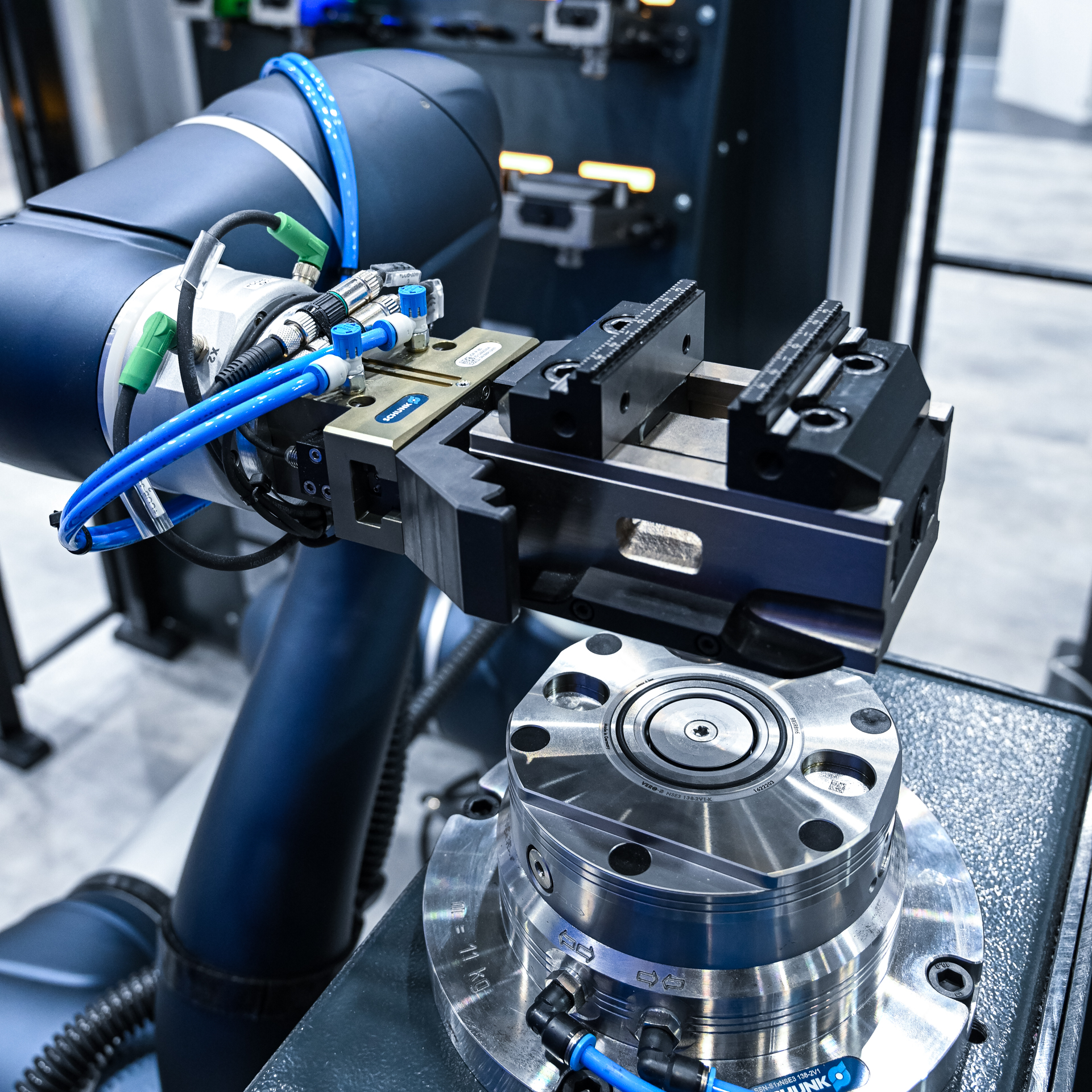
vices: the R-C2 module from Gressel on the robot arm
Storage automation for long runtimes
The round storage and robot automation system from STS, a Heller Group company, works with 17 storage locations for pallets, meaning that long runtimes can be achieved. “The storage does not limit the machine’s performance in any way in terms of weight and interfering contours,” emphasizes Marcus Genkinger, Managing Director of STS. “It can therefore be loaded with whatever the machine can handle.” The circular buffer is loaded via two integrated loading stations, which enable set-up to take place parallel to production. To allow Falser to operate flexibly, these are a station for manual set-up and an automated set-up station where the robot cell can be loaded with up to 800 kilograms. “Our storage automation is not a specific solution. As a standardized system with variation options, it can be scaled for machines from different manufacturers,” says Genkinger. “This applies to the circular storage system, but even more so to the robot cell. Overall, we are therefore very flexible in terms of machine connection.” He also describes the circular storage system as low-maintenance and durable.
machining six sides unmanned
Falser uses the R-C2 automation from Gressel for workpiece clamping via robot loading. This gives him the opportunity to automate very different parts. No special programming knowledge is required for this; he simply sets up the dimensions of a new part in the operating software. “This usually takes 15 to 30 minutes,” confirms Falser. In order to use the work area of the HF 5500 as efficiently as possible, a clamping device was designed on which four clamps can be positioned. Good accessibility is achieved for the first clamping operation via a 45-degree position, while the sixth side is machined horizontally for the second clamping operation. “Basically, we can load four workpieces at once”
describes Andreas Brunhofer, Product Specialist Automation at Gressel.
“As soon as the quantities increase, a second or third device can be added. For example, machining can be carried out autonomously from the storage facility over the weekend. Our transfer station automatically transfers from OP10 to OP20 without an employee having to reclamp anything. “
Andreas Brunhofer, Product Specialist Automation at Gressel
The clamping forces on the electric vice are set by the R-C2 module. It is also crucial that the parts are not embossed outside the system, but by the robot during gripping. “The vice has a special spindle bearing so that it can apply the necessary force for embossing,” explains Brunhofer. At the same time, the R-C2 system can also be used to automate bulky workpieces. Users can create the forming jaws themselves. By using two sizes of the 125 mm vice, Falser has so far been able to cover all desired dimensions for cubic parts. This saves having to keep countless different vices in stock.
The results that Falser Maschinenbau has achieved with the production cell speak for themselves. Not only is set-up now much faster, but throughput times have also been shortened, allowing the company to deliver faster. “We also produce higher quality immediately. We used to adhere to the tolerances, but we had to rework from time to time. Today, the parts come out of the machine perfectly. The number of sample and reject parts has also fallen significantly. We have therefore made a leap in quality. And whereas five or six employees used to be involved in the production of some parts, today it’s just one.” Looking to the future, you have to say “three”, because the new system means that three-shift operation is now planned again.
“In three or four years, we want to be ready to supply our customers with complete kits for their machines,” says Falser, looking ahead. “This will allow us to act as a full-service provider in mechanical engineering and have the entire value chain in-house. The customer benefits from our quality guarantee, saves on logistics and labor and increases their turnover. For these customers, who are based in South Tyrol, Switzerland and Germany, we have made a bold decision to position ourselves competitively.”

Falser Mechanical Engineering