Profitable multiplication of a manufacturing concept
In 2017, Rohde & Schwarz implemented a chained production line for the automated milling of aluminium parts at its Teisnach site. After several sister plants were implemented in the following years, the first plant has now been expanded to include automated raw part handling. Gressel has been a partner for workpiece clamping technology throughout all these years.
The milling division in Teisnach is divided into two areas, each with precise time specifications for order processing. The department headed by Georg Kauschinger, Head of CNC Milling Horizontal, has to adhere to a throughput time with an exact daily target from the moment an order is received. Taking into account associated processes such as material procurement and delivery, this leaves just over half of these days for machining to complete the respective order. Although certain products are manufactured in low four-digit quantities over the course of a year, the individual batches are in the double-digit range. On the other hand, the throughput time only allows for this order of magnitude. The daily target has been defined since Rohde & Schwarz put the interlinked system into operation.
From a single machine to an interlinked system
In 2017, the company set out to implement this ambitious project. The first step was to conduct internal exploratory discussions: “Where exactly do we want to go? Which components are suitable? Which partners can we work with to implement this?” explains Kauschinger. One thing was clear: the company wanted to move away from individual machines to larger systems. Several 5-axis machining centres were to be supplied with parts via a pallet handling system. Ultimately, four identical “Heller HF 5500” machines were selected, which are connected via a “PHS 1500” from Liebherr and fed by a rail-bound handling system. One of the most important reasons why Rohde & Schwarz chose the PHS 1500 was its master control system, as this was already in use in a smaller system with two interlinked machines in-house. “Based on our positive experience, we now wanted to expand the consistency,” says Kauschinger. “That’s why we decided on ‘Soflex’.”


In one of the linked systems at Rohde & Schwarz in Teisnach, four identical Heller HF 5500 machines are connected via a PHS 1500 pallet handling system … (Images: Gressel)

Designed for expansion
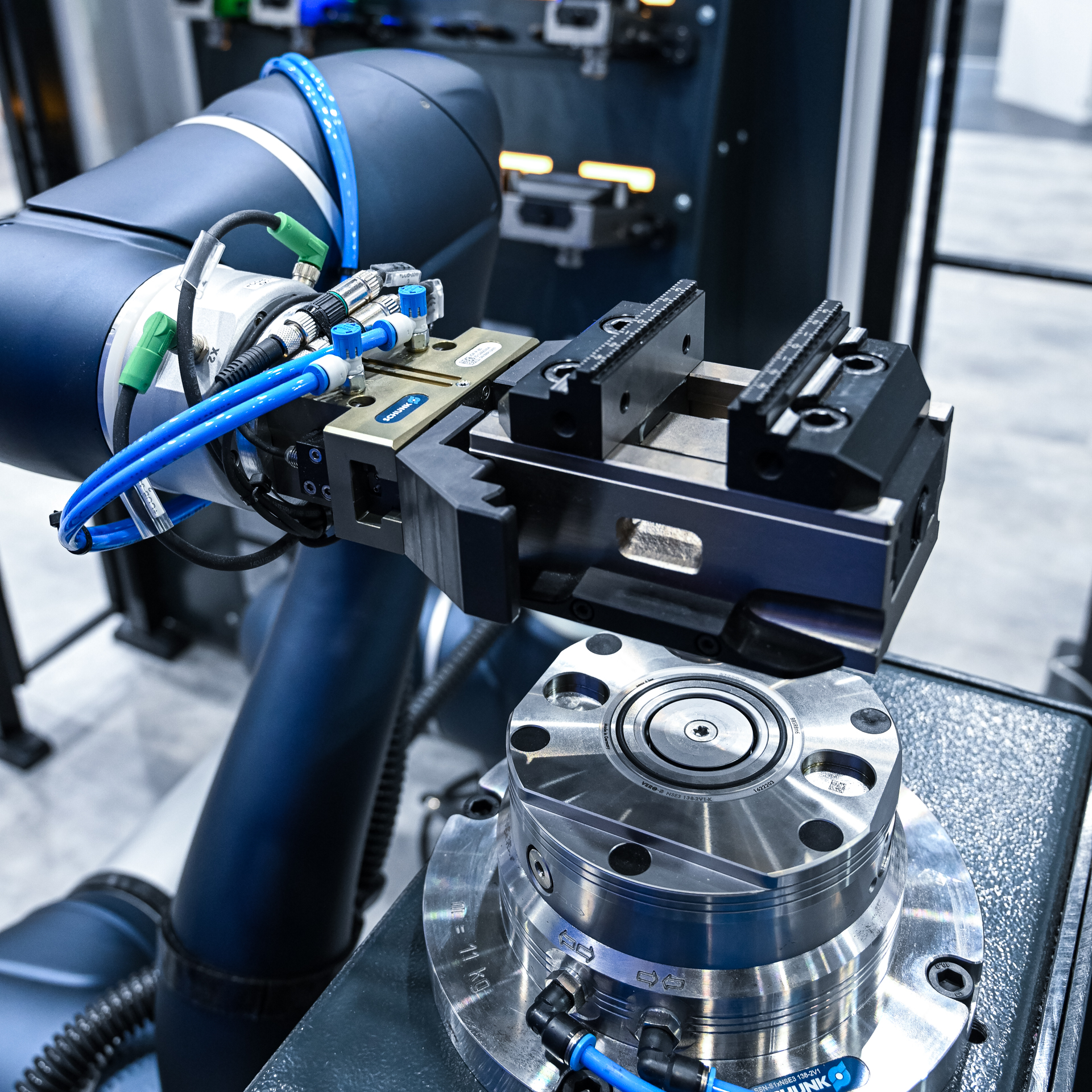
Like the production control system, the entire production concept was designed from the outset with connectivity and expansion options in mind. And so it quickly became clear that, when the time came, raw material handling would also be integrated into the system. Whereas the PHS could originally accommodate 69 pallets, the number of spaces would then be reduced by six. “But that was the plan,” emphasises Kauschinger. With the material that is processed in this configuration, Rohde & Schwarz is still going strong today: only aluminium is machined. In order to maintain the planned cycle time, the components are almost without exception fixed using multiple clamping systems, for example pyramids with three clamping points. “We use our ‘C2.0’ centric clamps in various sizes, the ‘S2’ fixed jaw clamp with a jaw width of 125 and the ‘gredoc’ mechanical zero-point clamping system,” reports Sokha Hem, sales engineer for AT & DE South at Gressel. “Ultimately, this allows parts up to 380 x 380 mm to be placed on the system.”

Up to 24 hours of unmanned production
In 2017, when the project was launched, it was impossible to predict what impact the manufacturing principle would have on the two milling departments. Ultimately, however, expectations were exceeded by far. This had direct consequences, as similar projects were now being planned. Not only in Kauschinger’s department, but also in the sister department, where a system should also include four machines, but now with raw part automation.
So what were the results of the first system that triggered this development? “First and foremost, of course, in the set-up time,” says Kauschinger. “Today, we are standardised at one third of the previous times. By linking the individual systems in conjunction with the standardised and optimised clamping system, we were able to improve the production process enormously compared to existing systems.” In addition, the number of staff required has been almost halved, allowing the employees concerned to take on other tasks. Against the backdrop of three-shift operation, the importance of unmanned machining has also increased massively. “The employees now organise how this is implemented themselves. Whereas we used to have an unmanned run-on time of a maximum of 3 to 5 hours, today it is up to 24 hours.”
Automatically load with raw parts
Currently, the raw parts loading of the first system is being phased in, with the parts being handled almost entirely automatically. Only at the beginning of the system are the pallets with raw parts moved into the pin-picking cell. From there on, everything runs automatically: scanning the production order and raw part data, destacking, measuring length, width and height. Defective parts are automatically ejected. All others are placed on shelves with several hundred spaces, a capacity that is based on the average part runtime that needs to be bridged over the weekend. In order not to occupy any clamping devices and to keep production as flexible as possible, the semi-finished parts produced over the weekend are temporarily buffered without clamping devices. “C2.0 centric vises, S2 single vises and the gredoc mechanical zero-point clamping system are used to fix the raw parts,” says Hem. Kauschinger adds: “As long as the raw parts have clean cubic shapes, we want to run everything through this handling system. The target is 95% of the raw parts.”

Sister facility joins the department
With the effects of the first system – reduced set-up times, optimised personnel deployment, unmanned production – it soon became clear that Kauschinger’s department would be getting a second system that copied the proven principle one-to-one. Again consisting of a 5-axis machining centre, pallet handling system and Soflex control system, it is only one size smaller, based on the workpieces. Here, too, raw part handling was initially dispensed with in order to later utilise the experience gained from the first system. “We can imagine it taking a year,” estimates Kauschinger. “If everything runs smoothly, we will then integrate raw part handling into the second system.” The workpiece clamping technology from Gressel is also identical, but one size smaller. “The smaller system again features C2.0 centric vises, S2 single vises and gredoc zero-point clamping systems,” confirms Hem.
Fewer types, more consistency
The fact that it was economical to copy the plant concept several times is primarily due to the detailed planning of the project partners. “Even before the respective project started, we had discussed all technical aspects from scratch in a series of meetings. Our design department worked closely with Gressel’s,” emphasises Kauschinger. “The aim was always to clarify as many questions as possible in advance and ultimately to use only standard components.”
Despite the wide variety of parts, this has led to “a significant reduction in the number of different types of clamping devices. At the same time, we have drastically increased the consistency of the systems and improved clarity. We now cover almost the entire range of parts with just a handful of clamping systems. Less than 5% of our production is now carried out on individual systems,” says Kauschinger with satisfaction. The large number of identical clamping systems also has the advantage that the required components are always available. “This means we are never in the awkward position of not being able to produce a part.”
System house for the entire service
Kauschinger is certain that the detailed clarification at the beginning of each project initially meant additional work, but ultimately saved a lot of problems and effort. Gressel is a partner that offers added value. For example, by providing a special tool for fixed jaw clamps, but also by offering a little help with operating the clamping devices. “There is a specific wrench size depending on the size,” explains Hem. “Rohde & Schwarz wanted this to be standardised. So we agreed on a wrench size of 27 and implemented it with the first system.” Technically not a major effort, it shows that Gressel is moving closer to the customer’s world in every detail. “For us, Gressel is therefore more than just a clamping device manufacturer,” emphasises Kauschinger. “For us, Gressel is a system provider from whom we receive a comprehensive service.”

Contacts
GRESSEL AG
Schützenstrasse 25
CH-8355 Aadorf
Phone: +41 52 368 16 16
E-Mail: info@gressel.ch
Web: www.gressel.ch
Rohde & Schwarz GmbH & Co. KG Werk Teisnach
Kaikenrieder Straße 27
D-94244 Teisnach
Phone: +49 9923 85710
E-Mail: info.teisnach@rohde-schwarz.com
Web: www.rohde-schwarz.com