Workpiece clamping at the next level
SLZ-Maschinenbau GmbH on the one hand and Schunk and Gressel on the other have enjoyed a long-standing partnership. What began a good twenty years ago with 5-axis clamps from Aadorf and now extends to tool clamping systems from Lauffen has taken its latest evolutionary step in Gressel’s “R-C2” automation system.
When Michael Gerhardt, responsible for production and milling technology at SLZ, lists the range of his milled parts, he needs a little time. “A central group consists of small series between 15 and 400 pieces, which we produce for our pharmaceutical equipment and systems,” he begins. “With sizes ranging from about 10 to 700 mm, 80% of these are aluminium parts, some of which are produced automatically.” For special machine construction, components designed in collaboration with the customer are regularly added. For parts sizes up to approximately 1200 mm, this is always single-part production. In addition, contract-manufactured series as repeat parts usually range from 50 to 1000 pieces, with all possible materials being used for these parts – from steel, stainless steel and POM to copper and brass. “We are currently working with carbon for the first time,” says Gerhardt. “In addition, we manufacture complex high-voltage products with dimensions of around 300 to 600 mm and batch sizes of between 10 and 30 pieces.” Gerhardt outlines another group with assembly production. Here, plates, strips and housings, mostly made of aluminium, are often processed for the manufacture of the required individual parts. “With a total of 70% of the parts, we are very focused on aluminium,” explains Gerhardt. “The remaining proportion is mainly divided between copper, POM and stainless steel.”

Flexibility is the be-all and end-all
When milling these parts on 3- and 5-axis machines, SLZ uses Gressel workpiece clamping systems without exception. “Today, many centric clamps are used on 5-axis machining centres, where we used to work with fixed jaw clamps. These systems greatly simplify milling, especially in 5-axis machining,” explains Gerhardt. This is primarily because his range of components requires a high degree of flexibility. “Since the site also has a turning shop, round parts also have to be clamped,” explains Marcel Ferenz, sales engineer for central Germany at Gressel. This is done with pendulum adapter plates that balance the parts. “For clamping irregular parts, we also use moulded jaws, which we often mill ourselves,” adds Gerhardt, as well as jaws for soft materials or multiple clamping. Because accessibility is one of his key requirements, “the clamping systems must be compact and must not have too long a spindle side, otherwise long tools would have to be used.”
High stability and vibration-free operation are crucial for both the tool and the clamping system. This is especially true for 5-axis clamps, which need to apply clamping force reliably even with taller structures. “The use of a zero-point clamping system poses a certain stability risk here due to the additional interface,” says Gerhardt. “However, because we only use Gressel products, we create an optimal interface and thus benefit from significantly greater flexibility and shorter set-up times. “This is particularly crucial in single-part production, where we are under considerable time pressure when it comes to set-up.” Last but not least, the durability of the clamping equipment is important to SLZ: “We are still working with 5-axis clamps that we purchased at the beginning of our collaboration,” reports Gerhardt.

Service will be further intensified
In addition to the “long-serving” “grepos-5X”, SLZ also uses Gressel “gripos” vises, “C2.0” centric vises with jaw widths of 80 and 125, and “S2” single vises with jaw widths of 125 and 160. This adds up to a total of around 40 Gressel systems on the machines, whose components can also be flexibly exchanged. The range is rounded off by vacuum and magnetic plates from Schunk. “We are very satisfied with the quality, service and advice,” says Gerhardt, explaining why they exclusively use Gressel and Schunk products. Any problems are dealt with just as smoothly as complaints or repairs. Consequently, there has never been any reason to switch. Why interfere with a system that works? “Especially since we have also been sourcing 80% of our tool holders from Schunk for years. So we source almost everything from a single supplier.” The fact that Gressel’s service has recently become even more intensive is partly due to Ferenz, who has been responsible for the area for a year. But it is also due to Gressel’s general ambition to further expand its presence in Germany. At SLZ, this was recently reflected in the new 5-axis centric clamping vise “C5X”, which was tested in Hanau-Großauheim for two weeks prior to EMO 2025. “The fact that we can test new products in the field here once again demonstrates the existing trust,” emphasises Ferenz.
Simply adjust to the correct tension
As an example of special clamping situations, Gerhardt cites a current carbon machining project in which low clamping force is the decisive factor. “We have set up three clamps on a 5-axis machine for this purpose because the workpiece also swivels,” he reports. “The three 5-axis vises give us a large contact surface, which prevents vibrations.” Ferenz adds: “The grepos-5X is ideal for this thanks to its cassette. The employee cannot set the wrong clamping force: they simply adjust it using the force adjustment scale attached to the clamp, which prevents the component from being overclamped.” This also applies to other deformation-critical applications, emphasises Gerhardt: “In some cases, we pre-anneal components to prevent deformation during machining. A large contact surface is particularly beneficial for longer parts.”

According to Ferenz, clamping larger aluminium plates can also be difficult. However, the correct clamping force and support must be ensured to prevent the plates from vibrating. After all, with lengths of 600 mm and widths of 400 mm, parallelism must be accurate to one hundredth of a millimetre. “That’s why we clamp such plates with the S2 single vise. If the plates are even larger, we use the vacuum plate. The plates are usually machined with a 3-axis machine, of which we have three at our disposal. In order to generate as much support surface as possible, we sometimes work with four vises.

In order to address the specific requirements of the parts and machining, SLZ uses different grip levels. The options range from aluminium to hardened grip jaws. “For our production parts that run automatically, we sometimes only need clamping forces of 10 to 15 kN,” says Gerhardt. “Then we reduce the grip on the jaws slightly so that the production part does not jam when the jaws are released.” Specifically: While SLZ used to always machine production parts with grip jaws in the first clamping, stepped jaws have now proven themselves in the course of the recently introduced automation.
Evolution continues
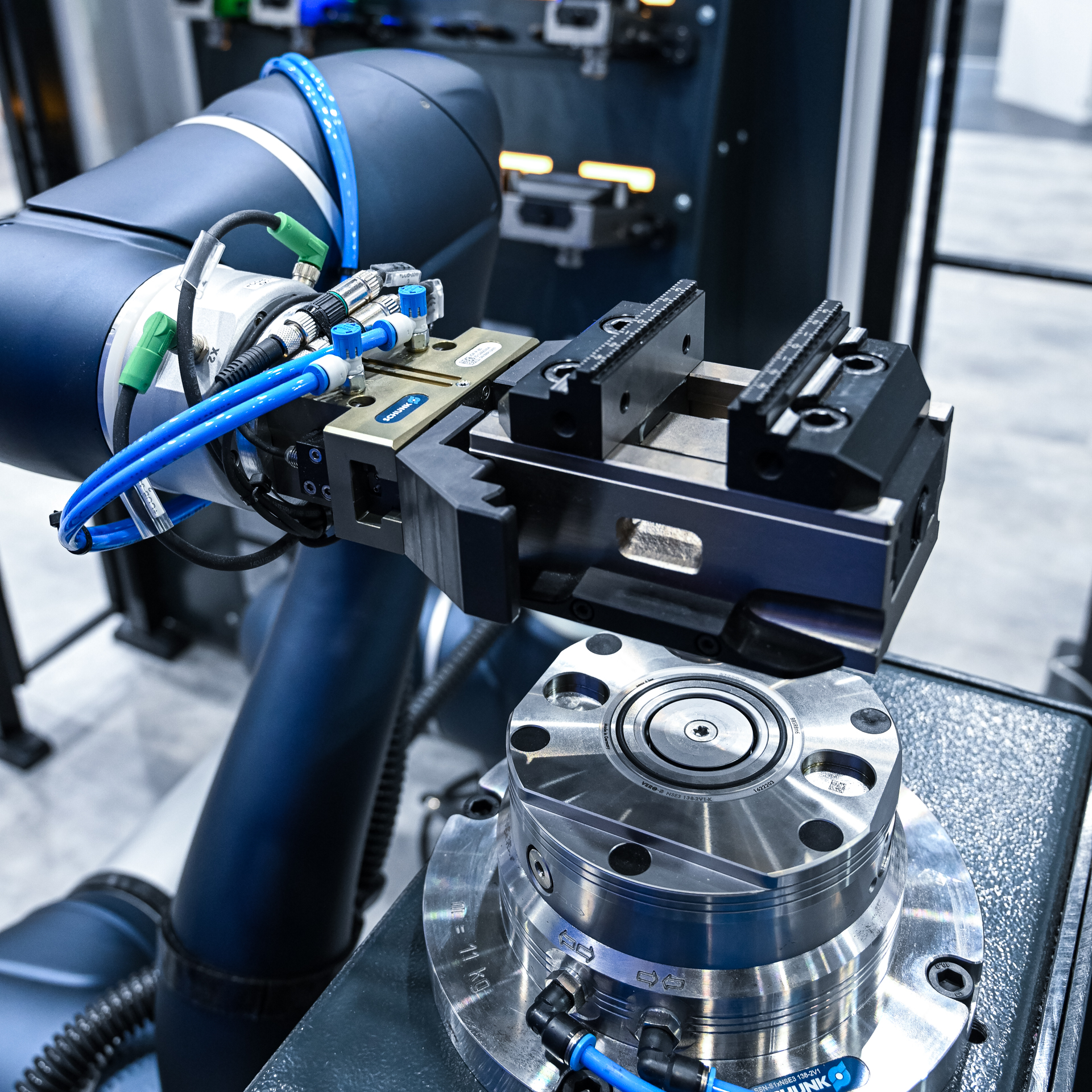
Automation refers to a new system that SLZ has been operating since March 2025. In order to produce small and medium-sized series for the pharmaceutical sector in particular, a five-axis “Spinner U630” with a rotary tilt table was equipped with a “Robobox” robot cell and “R-C2” automation from Gressel. To keep machine running times high, the system continuously processes additional workpieces, including complex individual parts. The robot cell has seven drawers with inlays and various grids for storing the parts. This allows components up to 250 mm long and 150 mm wide to be stored and processed. “Depending on the inlay, each drawer can hold between 8 and 50 parts to be processed, whereby we have almost exclusively opted for aluminium as the material.”
As a workpiece automation system, Gressel’s R-C2 system is fundamentally designed for unmanned 6-sided machining. For this complete production process, Gressel has combined 6-sided machining with robot direct loading in a new way. In the drawer, the workpiece is clamped by the R-C2 centric clamping device without pre-stamping and inserted into the machine by a robot using the R-C2 module. For machining, the centric clamping device is then fixed in the machining centre together with the workpiece on the zero-point clamping system. Once machining in OP10 is complete, the robot removes the centric clamping device from the machine. This is followed, if necessary, by automatic reclamping using the Gressel 6-sided station and machining in OP20. For even greater flexibility, the system can also be operated without a robot as a normal 5-axis machine.


Equipped for every requirement
Before the production cell was commissioned, the parts were manufactured on 3- or 5-axis machines, depending on their complexity and capacity. “On the 3-axis machining centre, we always tried to generate runtime via multiple clamping. With the new system, we have significantly increased output in comparison. This is particularly due to additional runtimes at night or over the weekend,” Gerhardt sums up. “This goes hand in hand with unmanned production, so that employees – especially when there is a lot of single-part production – can now take on other tasks.” In the meantime, they have already familiarised themselves well with the processes. A lot has been manufactured in OP10, and now they have moved on to processing in OP20. Of course, appropriate tests are also necessary here. “For example, we also want to test mould jaws and see how the robot works with them.” Ferenz emphasises: “Special jaws can then be manufactured in-house again. This is also thanks to the simple jaw interface. When you have been working with clamping devices for as long as SLZ has, you ultimately have a wide range of jaws at your disposal. And you are equipped to meet any requirement.

Engineering Group
Die SLZ-Maschinenbau GmbH and the Schönfelder engineering office are two companies that have been working closely together for three decades in the development, design, manufacture and documentation of special-purpose machines and prototypes. While engineering office Schönfelder has been the go-to place for machine development and design since 1988 and has become a problem solver for general machine construction as well as prototype and special machine construction, SLZ-Maschinenbau GmbH, founded in 1996, is considered the top choice when it comes to the manufacture of custom-made products, prototypes and small and medium series. The business areas of the Schönfelder engineering offices also specialise in precision engineering, fixture and steel construction, and FEM analysis. SLZ-Maschinenbau GmbH builds For the pharmaceutical industry, for example, laboratory equipment or systems for vaccine production, but also machines for food production and injection moulding machines for innovative materials. In addition, components are manufactured on a contract basis and design services are provided, including electrical services. In addition to the pharmaceutical industry, the solar industry, the packaging and food industry, and manufacturers of high-voltage products also benefit from such services.
Contacts
Gressel AG
Schützenstrasse 25
CH-8355 Aadorf
Phone: +41 52 368 16 16
E-mail: info@gressel.ch
Web: www.gressel.ch
SLZ-Maschinenbau GmbH
Josef-Bautz-Straße 2
D-63457 Hanau-Großauheim
Telefon: +49 6181 30792-0
E-Mail: info@slz-maschinenbau.de
Web: www.slz-maschinenbau.de